Bearing the Load: Identifying Load Bearing Walls
April 11, 2019 So far this year, Philadelphia has had three building collapses due to improper work being performed on load bearing walls, a substantial uptick from years past. It’s important to keep in mind when performing or specifying work on properties to always pay attention to the structural elements. Here are some ways to know that a wall is load bearing. Disclaimer, I am not a structural engineer nor am I providing advice on your specific property, when performing any kind of potential structural work always consult with a licensed specialist.
What does it mean to be a load bearing wall? Load bearing walls bear load. This means they are supporting weight and if they are removed, damaged, or undermined they risk collapsing leaving the rest of that weight to be unsupported, often resulting in significant structural damage or collapse.
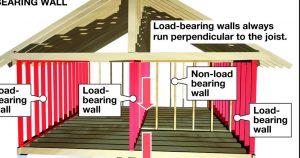
[diagram of load bearing walls]
Load bearing walls typically have joists resting upon them. When joists run perpendicular to a wall, that wall is often bearing some of the load from the joists and whatever may be above them. In rowhouses, which are exceedingly prevalent in Philadelphia, joists tend to run from one party wall to the other. This means that in many rowhouses the exterior masonry including the party walls are load bearing. Walls that run parallel to the party walls also have the potential to bear load since the joists will be spanning them. However, with every rule is an exception. Many row homes will have portions where joists run front to back, sometimes even for only a portion of the house. This is particularly common when staircases are oriented front to back. The reason is that it was often easier for the stairwell to penetrate through the floors parallel with the joists than perpendicular since this would require fewer cripple joists (there are, of course, exceptions).

[framing around floor penetration]
Additionally, many top floors in row homes have attic joists that run front to back if the roof pitches front to back, this is common even if the lower floors had side to side joists. This means your load bearing walls on the top floor may run perpendicular to the load bearing walls on the lower floors.
When dealing with brick masonry, which is again very common in Philadelphia, it is important to know the difference between a structural brick wall and a brick veneer or façade. Often, rowhomes will have a single layered brick façade with a structural brick wall behind it. When looking at a brick wall if you see rows of bricks turned on end so you see the narrow edge, this is called a header and it is used to tie together multiple wythes, or layers. Typically, this would signify that the brick wall you’re looking at is structural and so most likely load bearing. But remember, you may not see any header bricks if there’s an aesthetic façade in front of the load bearing layers of brick.
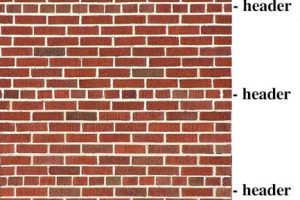
[brick wall with header courses]
Foundations are load bearing, always consult a professional when performing foundation work.
When in doubt, always consult a professional, and let’s work to keep every person and property in our community safe.